Vitamin D Calculator
Vitamin D3 loading and maintaining dose calculator


Despite the inverse association between serum 25(OH)D3 concentrations and age-adjusted all-cause mor t ality rates [1, 2], the benefits of increasing vitamin D levels above 20–30 ng/ml in blood tests are disputed; additional vitamin supplementation reduces all-cause mortality by just 6% [3], which is an equivalent of less than 7 additional months of life and not associated with lower rates of invasive cancer or cardiovascular events [4]. Moreover, there is a notion that the serum 25(OH)D3 in is actually a surrogate marker of the level of insolation, which is accountable for the benefits commonly associated with the vitamin D. Indeed, sunlight protects against high blood pressure and cardiovascular [5–7] and other diseases [8–10], probably via elevation of nitric oxide stimulated glucose transport and other nitric oxide-dependent mechanisms [10–12].
Nevertheless, deficiency of vitamin D correlates with higher rates of common chronic diseases such as bone metabolic disorders, tumors, cardiovascular diseases, diabetes, sleep disorders, cognitive impairment, autoimmune diseases, increased susceptibility to infection [13–17] and required rapid correction.
There are no universal schemes or recommendations for vitamin D3 intake for the correction of vitamin D deficiency conditions in adults. An effective dosage of the vitamin depends on many factors, such as diet, lifestyle, body fat percentage [18], age, baseline vitamin level [19], etc. For instance, larger waistlines are linked to a higher risk of vitamin D deficiency [20]. Body shape deviation in the population also independently associated with the mortality rates [21, 22]; you can check how ABSI independently from other factors affects your age here: https://bodyage.app/. The current version of the calculator does not take into account BMI and might provide an excellent ABSI age to underweight or overweight people, who actually have higher mortality risks [23].
A massive number of contradictory guidelines inspired me to create an online calculator to investigate the impact of some of those factors and estimate an optimal dose and duration of vitamin D3 intake: https://d3dose.app/.
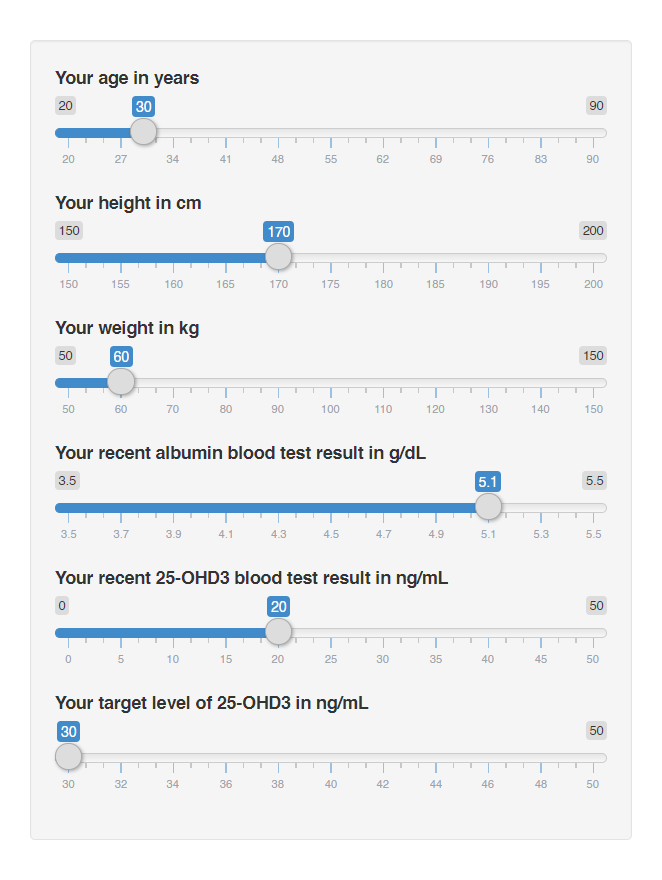
The main formulas and recommendations for imputation were taken from Dr. Van Groningen's vitamin D3 loading dose protocol [24] and the observational study of thousands of episodes of the vitamin replacement [25].
While there is rare toxicity in trials conducted in healthy adults that used vitamin D3 dose more than 10 000 IU per day [26, 27] taking too much vitamin can create health risks. Vitamin D3 overdose leads to symptoms such as nausea, vomiting, altered sensorium, constipation, pancreatitis, acute kidney injury, and weight loss [28].
This calculator is intended for illustrative and educational purposes only and is not warranted for any medical use. The recommendation is not intended to be a substitute for professional medical advice, diagnosis, or treatment. Always seek the advice of your physician with any questions you may have regarding a medical condition.
About the author: Denis Odinokov, MBBS, MSc, PMP. A trained physician, bioinformatician, seasonal research and project manager, Mr. Odinokov has pursued a career focused on longevity research and data science.
References:
1. Garland, C.F., et al., Meta-analysis of all-cause mortality according to serum 25-hydroxyvitamin D. Am J Public Health, 2014. 104(8): p. e43–50.
2. Schottker, B., et al., Serum 25-Hydroxyvitamin D Levels as an Aging Marker: Strong Associations With Age and All-Cause Mortality Independent From Telomere Length, Epigenetic Age Acceleration, and 8-Isoprostane Levels. J Gerontol A Biol Sci Med Sci, 2019. 74(1): p. 121–128.
3. Zheng, Y., et al., Meta-analysis of long-term vitamin D supplementation on overall mortality. PLoS One, 2013. 8(12): p. e82109.
4. Manson, J.E., et al., Vitamin D Supplements and Prevention of Cancer and Cardiovascular Disease. N Engl J Med, 2019. 380(1): p. 33–44.
5. Weller, R.B., Sunlight Has Cardiovascular Benefits Independently of Vitamin D. Blood Purif, 2016. 41(1–3): p. 130–4.
6. Scragg, R., J. Rahman, and S. Thornley, Association of sun and UV exposure with blood pressure and cardiovascular disease: A systematic review. J Steroid Biochem Mol Biol, 2019. 187: p. 68–75.
7. Feelisch, M., et al., Is sunlight good for our heart? Eur Heart J, 2010. 31(9): p. 1041–5.
8. Monserrat-Garcia, M.T., et al., RF- Insufficient Exposure to Sunlight and Global Mortality: Should We Advise Against or Recommend Sun Exposure? Actas Dermosifiliogr, 2017. 108(3): p. 257–258.
9. Yoon, U.A., et al., The impact of sunlight exposure on mortality of patients with end stage renal disease. Sci Rep, 2019. 9(1): p. 2230.
10. Gorman, S., et al., Can skin exposure to sunlight prevent liver inflammation? Nutrients, 2015. 7(5): p. 3219–39.
11. Higaki, Y., et al., Nitric oxide increases glucose uptake through a mechanism that is distinct from the insulin and contraction pathways in rat skeletal muscle. Diabetes, 2001. 50(2): p. 241–7.
12. Holliman, G., et al., Ultraviolet Radiation-Induced Production of Nitric Oxide:A multi-cell and multi-donor analysis. Sci Rep, 2017. 7(1): p. 11105.
13. Wang, H., et al., Vitamin D and Chronic Diseases. Aging Dis, 2017. 8(3): p. 346–353.
14. Muscogiuri, G., Vitamin D: past, present and future perspectives in the prevention of chronic diseases. Eur J Clin Nutr, 2018. 72(9): p. 1221–1225.
15. Gao, Q., et al., The Association between Vitamin D Deficiency and Sleep Disorders: A Systematic Review and Meta-Analysis. Nutrients, 2018. 10(10).
16. Aranow, C., Vitamin D and the immune system. J Investig Med, 2011. 59(6): p. 881–6.
17. Schottker, B., et al., Strong associations of 25-hydroxyvitamin D concentrations with all-cause, cardiovascular, cancer, and respiratory disease mortality in a large cohort study. Am J Clin Nutr, 2013. 97(4): p. 782–93.
18. Martinaityte, I., et al., Vitamin D Stored in Fat Tissue During a 5-Year Intervention Affects Serum 25-Hydroxyvitamin D Levels the Following Year. J Clin Endocrinol Metab, 2017. 102(10): p. 3731–3738.
19. Chen, P.Z., et al., Pharmacokinetics and effects of demographic factors on blood 25(OH)D3 levels after a single orally administered high dose of vitamin D3. Acta Pharmacol Sin, 2016. 37(11): p. 1509–1515.
20. Rafiq, R., et al., Associations of different body fat deposits with serum 25-hydroxyvitamin D concentrations. Clin Nutr, 2018.
21. Krakauer, N.Y. and J.C. Krakauer, A new body shape index predicts mortality hazard independently of body mass index. PLoS One, 2012. 7(7): p. e39504.
22. Krakauer, N.Y. and J.C. Krakauer, An Anthropometric Risk Index Based on Combining Height, Weight, Waist, and Hip Measurements. J Obes, 2016. 2016: p. 8094275.
23. Lee, D.H., et al., Predicted lean body mass, fat mass, and all cause and cause specific mortality in men: prospective US cohort study. BMJ, 2018. 362: p. k2575.
24. van Groningen, L., et al., Cholecalciferol loading dose guideline for vitamin D-deficient adults. Eur J Endocrinol, 2010. 162(4): p. 805–11.
25. Singh, G. and A.J. Bonham, A predictive equation to guide vitamin D replacement dose in patients. J Am Board Fam Med, 2014. 27(4): p. 495–509.
26. Hathcock, J.N., et al., Risk assessment for vitamin D. Am J Clin Nutr, 2007. 85(1): p. 6–18.
27. Vieth, R., Vitamin D toxicity, policy, and science. J Bone Miner Res, 2007. 22 Suppl 2(S2): p. V64–8.
28. Kaur, P., S.K. Mishra, and A. Mithal, Vitamin D toxicity resulting from overzealous correction of vitamin D deficiency. Clin Endocrinol (Oxf), 2015. 83(3): p. 327–31.
Source: https://medium.com/@denis.odinokov/vitamin-d3-loading-and-maintaining-dose-calculator-f0bd681b5cf3

Komentar :
Posting Komentar